

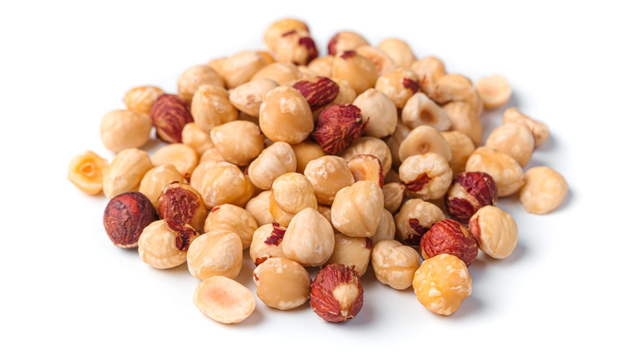
Roasted hazelnuts
AmaNut Italy roasted hazelnuts are made from carefully selected raw materials and undergo a controlled roasting process designed to enhance their aromatic profile. Our products are intended for chocolate makers, pastry shops, gelato producers, food manufacturers and industry professionals.
Roasted hazelnuts for professional use
Roasting is one of the most important stages in hazelnut processing. Precise control of processing parameters allows us to enhance the hazelnuts' aroma and organoleptic characteristics.
For this reason, we use professional roasting technologies that ensure uniform processing and accurate roasting control, starting with hazelnuts from our supply chain, carefully selected before processing.
Different roast levels to suit different needs
Different applications may require different aromatic characteristics. AmaNut Italy therefore offers different roasting levels, developed to meet the specific needs of professionals and companies in the food industry.
Careful process control allows us to manage roasting accurately and enhance the aromatic profile of each batch, producing hazelnuts suitable for a variety of professional applications.
Roasted hazelnuts for pastry, gelato and the food industry
Roasted hazelnuts are used in numerous food preparations and are a valuable raw material for both artisan workshops and larger manufacturing companies.
Our products are particularly suitable for pastry shops, gelato producers, food manufacturers, industry professionals and distributors looking for hazelnuts processed under controlled conditions and sourced from a traceable supply chain.
From cultivation to roasting, a supply chain under our control
The quality of our roasted hazelnuts begins long before roasting. AmaNut Italy directly manages its hazelnut orchards in Piedmont and oversees the subsequent stages of harvesting, cleaning, drying, shelling and raw material selection.
Before roasting, the hazelnuts also undergo an optical sorting process that identifies and removes nuts that do not meet the required quality standards.
Direct control over the different stages allows us to know the origin of our raw materials and trace their journey to the finished product.